Nibs are ground into liquid cacao and refined with sugar until the particles are around 20 microns. The mass is conched for hours or days to soften acidity and round the texture. Then it is tempered so the cocoa butter sets in the one crystal form that gives gloss, snap and a clean melt.
Each step is a choice. Long conching makes a smoother, milder bar. Short conching keeps more of the origin's sharp edges.
Grinding the nib
Cacao nibs are about half fat. Grind them and the cocoa butter melts in the heat of the friction, so the nibs turn into a thick brown liquid called chocolate liquor. That liquor is 100 percent cacao, and its fat is the reason a good bar melts on your tongue.
Small makers often use a stone melanger, a drum with granite wheels rolling on a granite base. Larger makers use hammer mills, ball mills and roll mills. Dick Taylor runs its nibs through a hammer mill, then a ball mill for about six hours to reach 20 microns. Then a roughly half-and-half mix of sugar and liquor goes through a roll mill three times. All that milling is why its bars feel smooth while tasting of the bean.
 11:25
Refining
Refining grinds the sugar and cacao particles small enough that your tongue cannot feel them. Most makers aim for about 15 to 30 microns. Dandelion wrote in 2015 that its melangers took batches to about 25 microns, with a target range of 20 to 29. Go too fine, below about 10, and chocolate can turn gummy and thick. In the sweet spot the melt feels soft and even.
A bar that feels sandy was stopped early, sometimes by choice. A few makers grind coarser for a rustic texture, which is a style: you will know it when you bite. Taza Chocolate in Somerville, Massachusetts, is the best known. It stone grinds on hand-carved granite millstones and keeps the texture gritty by design, closer to the way chocolate was made in Mexico for centuries. A Taza bar crunches faintly and melts slowly, and if you go in expecting silk it will surprise you. Taste it as its own thing.
| Particle size | What your tongue notices |
|---|---|
| Over 35 microns | Gritty or sandy |
| 20 to 30 microns | Smooth, typical of craft bars |
| Under 15 microns | Very silky, can feel thick or pasty |
Conching
Rodolphe Lindt built the first conche in Bern in 1879, a granite roller rocking through a granite trough. Before it, chocolate was coarse. After it, chocolate melted.
Conching keeps the chocolate warm and moving for hours or days. Air passing over the surface carries off moisture and volatile acids like acetic acid left over from fermentation. The motion coats every particle in cocoa butter, rounding the texture. Flavors mellow and blend.
How long is a maker's call. Dick Taylor conches for 24 to 48 hours, starting dry for the first day before adding more liquor. Dandelion used a 200 kg rotary conche for 48 hours in its 2015 experiment. Industrial rotary conches can finish multi-ton batches in under 12 hours. Dark chocolate is often conched hotter than milk, up to about 80 °C.
The trade-off is real. A long conche makes a smooth, mellow bar. A short one keeps more of the bright, sharp origin notes, and some makers prefer exactly that.
Aging
Many craft makers rest the finished chocolate in blocks for days or weeks before tempering it into bars. Flavors settle and harsh edges soften. It is not on most wrappers, and it is one of the quiet reasons small-batch bars taste finished.
Tempering
Cocoa butter can set in six different crystal forms, numbered I to VI, each with its own melting point, from about 17 °C to about 36 °C. Only one, Form V, gives the good stuff. It makes a glossy surface and a clean snap. The bar shrinks slightly so it releases from the mold, and it melts right around body temperature (Form V melts near 34 °C).
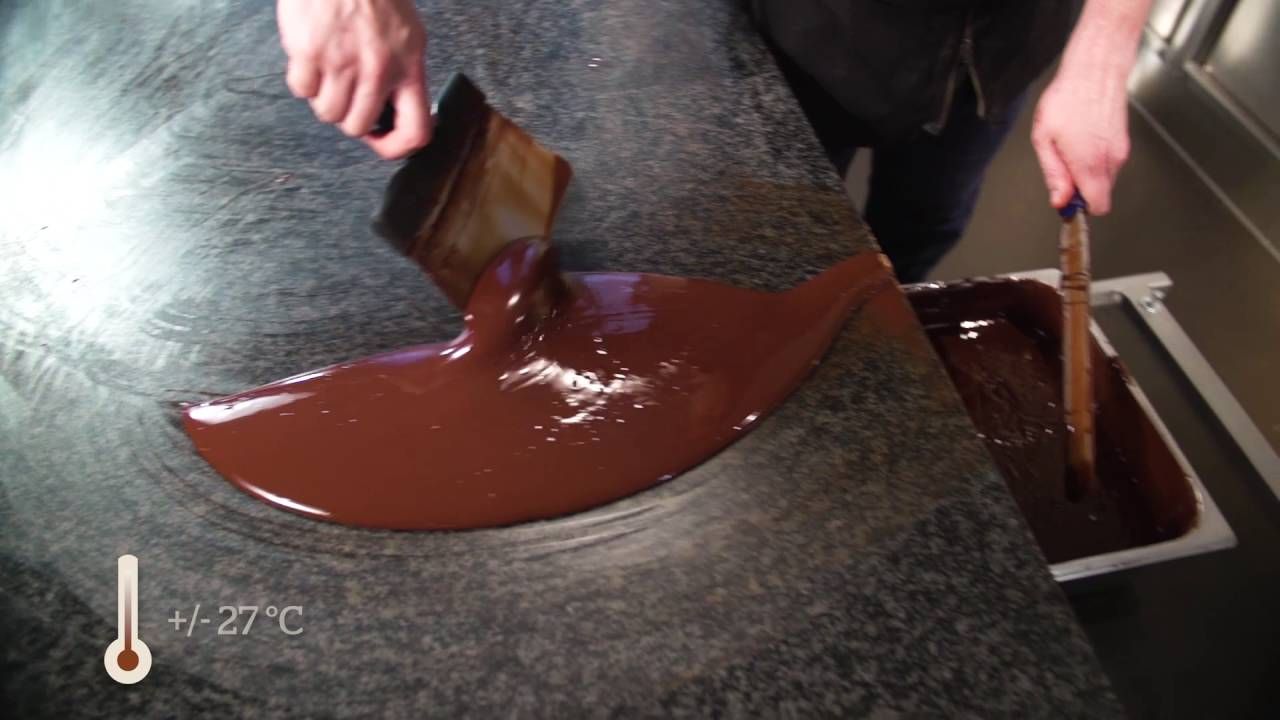
Tempering is how a maker gets mostly Form V. The chocolate is fully melted to wipe out every crystal, cooled while stirring so stable seeds form, then warmed slightly to melt any unstable ones. Callebaut's guide melts dark chocolate at around 45 °C and works it at about 31 °C. On a marble slab this is done by hand, spreading and scraping. In a factory a tempering machine does it continuously.
If it goes wrong, you see it right away: a dull, streaky, soft bar that bends instead of snapping.
| Sign | Tempered well | Tempered badly |
|---|---|---|
| Surface | Glossy, even | Dull, streaky, gray |
| Break | Clean, loud snap | Bends or crumbles |
| In hand | Holds a moment before melting | Melts on contact |
| Melt | Smooth and quick at body heat | Waxy or grainy |
 2:30
Molding and wrapping
Tempered chocolate is poured into molds, tapped or vibrated to knock out bubbles, cooled and popped out. Then it gets wrapped, often by hand at craft scale. Dick Taylor hand-letterpresses its envelopes on vintage presses it restored. From bean to bar, Dick Taylor says the whole run takes about three weeks.
Questions
What is conching in chocolate making?
Hours or days of warm stirring after grinding. It drives off moisture and volatile acids, coats particles in cocoa butter and mellows flavor. Rodolphe Lindt invented it in 1879.
How long is chocolate conched?
Anywhere from a few hours to three days. Dick Taylor conches 24 to 48 hours. Industrial conches can finish big batches in under 12 hours.
What is chocolate liquor?
Ground cacao nibs, which melt into a liquid because they are about half cocoa butter. It is 100 percent cacao. The name is old trade language for the liquid.
Why does chocolate need tempering?
Cocoa butter has six crystal forms. Tempering makes it set in Form V, which gives gloss, snap and a clean melt.
What particle size is smooth chocolate?
Most makers refine to about 15 to 30 microns. Above about 35, the tongue notices grit.
- Our process, Dick Taylor Craft Chocolate
- Le Grande Experiment, Part 1, Dandelion Chocolate
- Le Grande Experiment, Part 2, Dandelion Chocolate
- Conche, Wikipedia
- Cocoa butter crystal forms, Nature Communications (2021), Nature Communications
- 87% Seriously Dark, Taza Chocolate