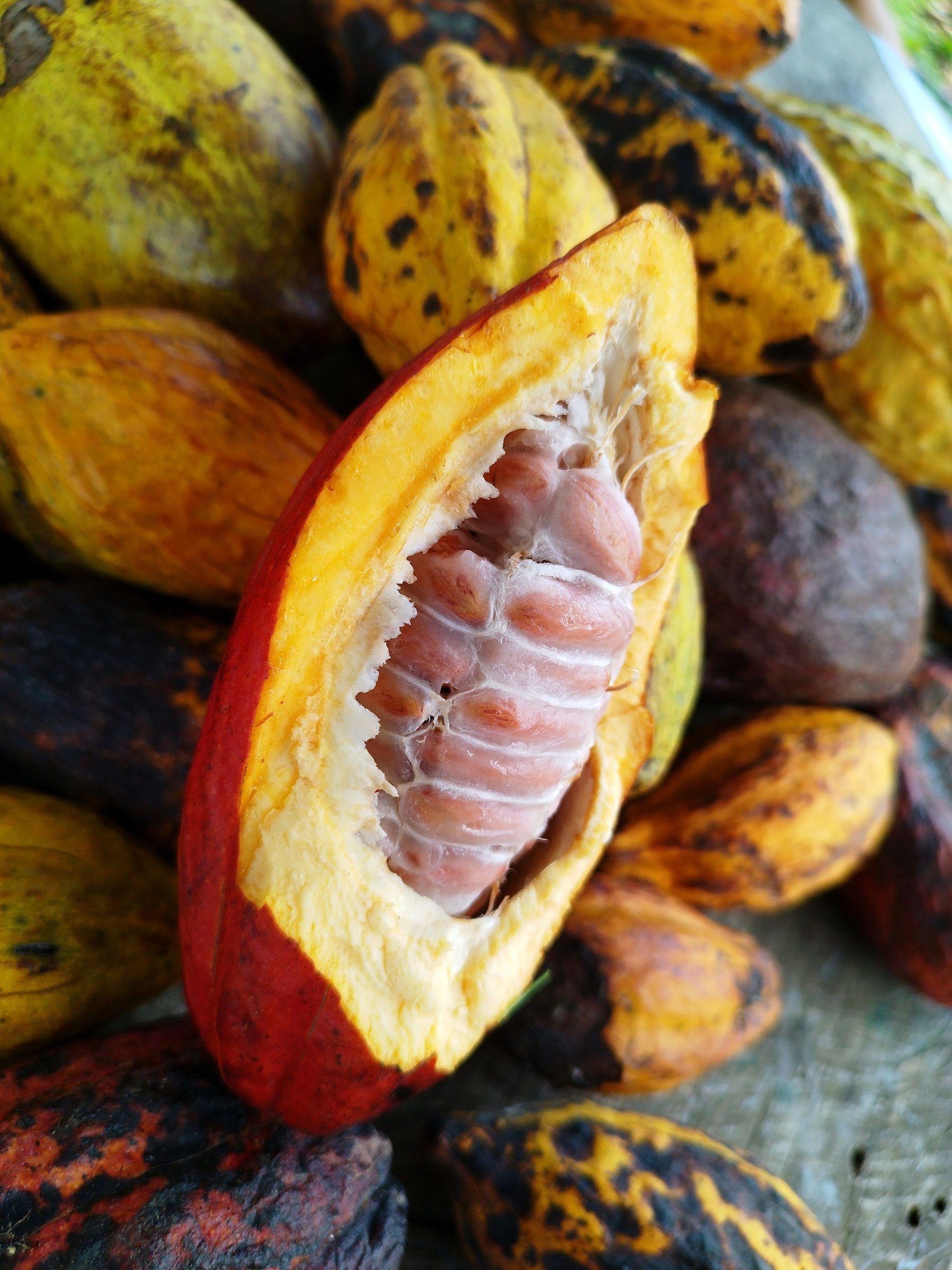
Fresh cacao beans taste bitter and astringent, nothing like chocolate. Fermentation in the pulp for about two to seven days, then slow drying in the sun for a week or more, creates the compounds that become chocolate flavor when the maker roasts the beans.
Too little fermentation leaves a bar flat and astringent. Too much makes it smoky, leathery or cheesy. That is why the fermentary's name on a wrapper means so much.
Opening the pod
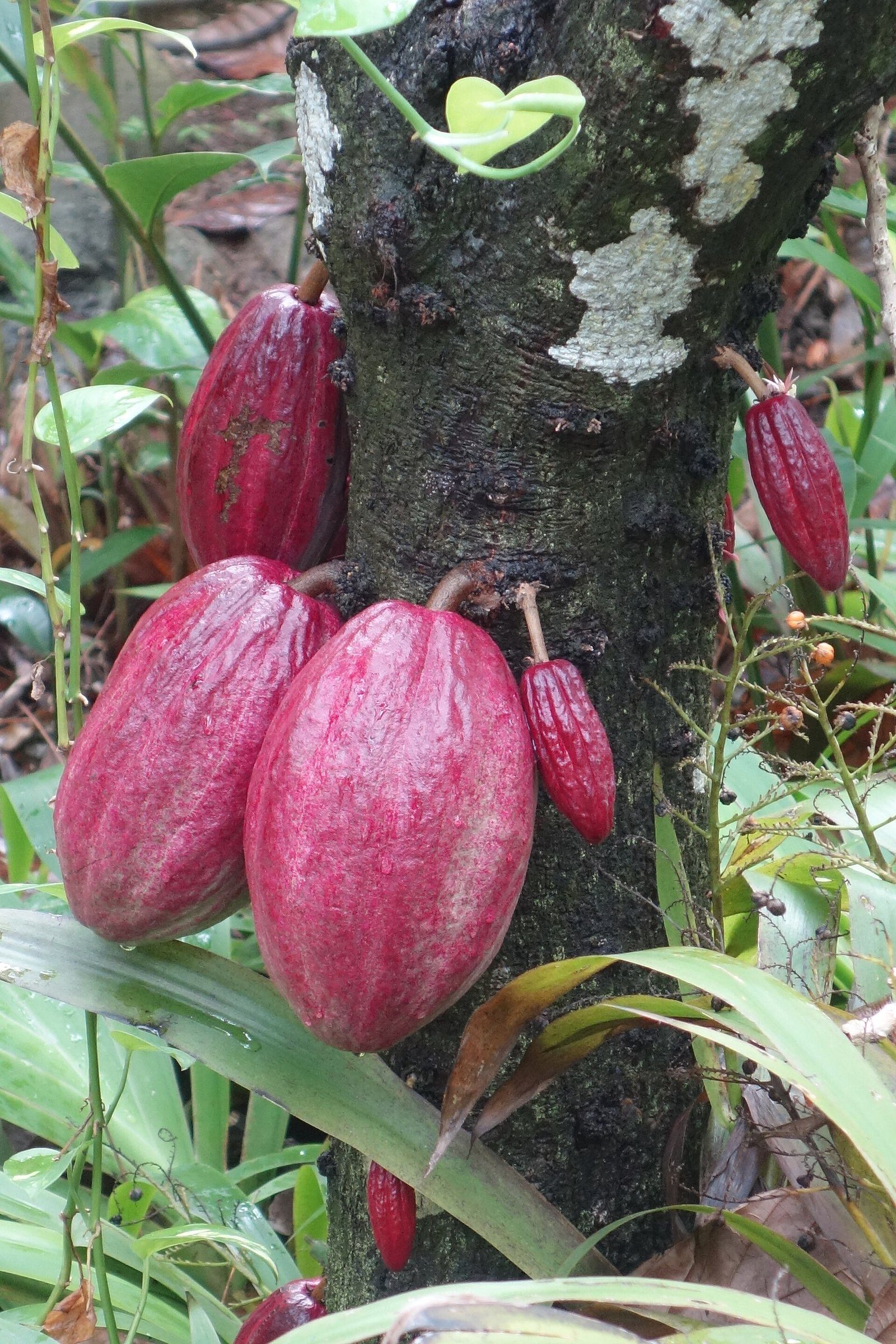
Pods grow straight off the trunk, ripen over five to six months, and hold 20 to 60 beans in a sweet, tart white pulp. The ICCO advises opening them within seven to ten days of harvest, and prefers a wooden club to a machete, which can cut the beans.
On many farms the beans are scooped out and fermented at home in small piles. More and more fine cacao is fermented centrally instead: a fermentary buys the beans "wet", straight out of the pod, and does the rest with more control. Kokoa Kamili in Tanzania and Maya Mountain Cacao in Belize both work this way.
 12:30
What happens in the box
Fermentation is a relay race between microbes. In the first day or two, yeasts feed on the sugary pulp in a low-oxygen pile and turn it into ethanol. As the pulp drains and air gets in, lactic acid bacteria and then acetic acid bacteria take over, and the acetic acid bacteria turn that ethanol into acetic acid. The pile heats up, to 40 to 45 °C in the first 48 hours by the ICCO's figures, and higher later.
The heat and acid kill the seed's embryo. Once the bean's cells break down, enzymes start turning proteins and sugars into the precursors of chocolate flavor, and the purple pigments begin to fade to brown.
Workers turn the mass to add air, or move it down a cascade of boxes. Kokoa Kamili uses a three-tier cascade, ferments for six days after a partial overnight drain, and logs the temperature throughout. Maya Mountain Cacao runs six to seven days in a line of boxes.
| Stage | Who is working | What it does |
|---|---|---|
| Day 1 to 2 | Yeasts | Eat pulp sugar, make ethanol, start the heat |
| Day 2 to 4 | Lactic acid bacteria | Make lactic acid as the pulp drains |
| Day 3 to 6 | Acetic acid bacteria | Turn ethanol into acetic acid. Heat peaks, the seed dies |
| After | The bean's own enzymes | Build flavor precursors, purple turns brown |
How long, and how to tell
Bean type changes the timing. The ICCO gives about five days for Forastero and two to three for the more delicate Criollo.
Researchers in a 2021 Scientific Reports review give a practical marker: a bean pH of 5.5 to 5.8 means fermentation was incomplete, below 4.75 means it went too far, and about 5.0 to 5.2 is the target.
The trade's quick check is the cut test: slice beans lengthwise and look. Well-fermented beans are brown and open-grained. Unfermented beans are "slaty", gray and smooth inside, and taste bitter and astringent. Over-fermented beans go nearly black and smell off.
In 2026, a team at the Technical University of Munich and the Leibniz Institute showed that over-fermentation can make the smoky, leathery and cheesy off-notes that were often blamed on smoke from drying fires.
Drying, slowly
Fresh fermented beans are about 60 percent moisture. They need to get down to about 7.5 percent to store and ship without mold.
The ICCO's guidance is to dry slowly. Dry too fast and acids get trapped, so the bar tastes sharp and bitter. Dry too slowly and the beans can mold. Kokoa Kamili sun-dries on raised tables for five to seven days, raking constantly. Maya Mountain dries on mesh decks under greenhouse plastic for seven to fourteen days. Where the weather will not cooperate, farms use wood or fuel dryers, which is where some smoky notes come from.
Sorting and roasting
Once the beans reach the maker, they are sorted by hand to pull out flat, broken or moldy beans. Dick Taylor says every bean goes past an employee's eye.
Roasting finishes what fermentation started. Heat drives off moisture and some harsh acids, loosens the shell from the nib, and runs the browning reactions that turn those flavor precursors into the chocolate notes we recognize. Each origin gets its own roast. Dick Taylor roasts on a Barth Sirocco from 1934 and gives each bean its own profile. Dandelion prints a roast level on some bars: its Kokoa Kamili 70% is a 2 out of 5, gentle enough to keep the fruit. Raaka skips roasting altogether for a brighter, fruitier bar.
A light roast keeps fruit and acidity. A darker one brings out nuts, caramel and cocoa and pushes the origin into the background.
Cracking and winnowing
Roasted beans are cracked into pieces, and air separates the light papery shell from the dense nib. Dick Taylor uses vacuum and vibrating screens and sends the shells to gardens as mulch. The nibs go on to be ground, which is the next guide.
Those nibs are the purest form of cacao you can buy. Sprinkle them on yogurt or crush them into a cookie dough and you are tasting exactly what the fermentary and the roaster made.
Questions
Why do cacao beans need to be fermented?
Fresh beans are bitter and astringent. Fermentation kills the seed and starts the reactions that create chocolate flavor precursors, which roasting then develops.
How long does cacao fermentation take?
Usually two to seven days. The ICCO gives about five days for Forastero and two to three for Criollo. Fermentaries like Kokoa Kamili run six.
How dry do cacao beans need to be?
From about 60 percent moisture down to about 7.5 percent, dried slowly over a week or more so acids escape and mold does not set in.
What does roasting do to cacao?
It dries the beans, loosens the shell and develops flavor through browning reactions. Lighter roasts keep fruit, darker roasts bring nutty and cocoa notes.
Why does some chocolate taste smoky?
Beans dried over wood fires can pick up smoke, and research from Munich in 2026 showed over-fermentation can produce smoky, leathery notes too.
- Harvesting and post-harvest, International Cocoa Organization
- Calvo et al., Dynamics of cocoa fermentation and its effect on quality, Scientific Reports (2021), Scientific Reports
- Operations, Kokoa Kamili
- Maya Mountain, Belize, Dandelion Chocolate
- Smoky off-flavors in cocoa aren't caused solely by smoke, The Microbiologist
- Our process, Dick Taylor Craft Chocolate
- Kokoa Kamili, Tanzania 70%, Dandelion Chocolate
- 100% Cacao, Raaka Chocolate